__lasx_concat_128_d
LASX intrinsic · group: Misc
Synopsis
__m256d __lasx_concat_128_d (__m128d lo, __m128d hi)
#include <lsxintrin.h>
#include <lasxintrin.h>
CPU Flags: LASX
Description
Concatenate two 128-bit double precision vectors. lo becomes the low 128-bit half and hi becomes the high 128-bit half.
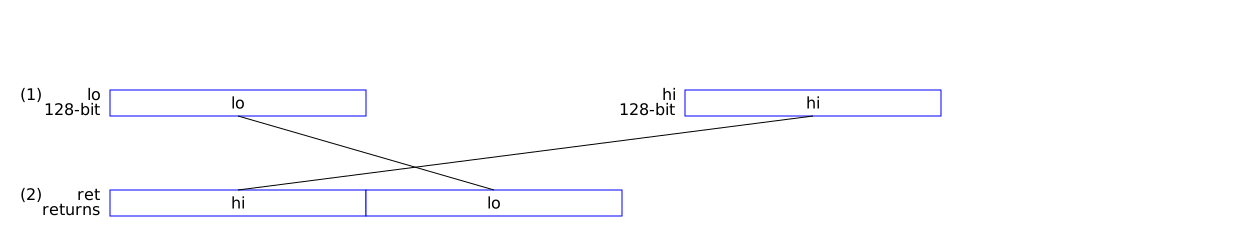
This helper intrinsic does not name a distinct LASX instruction. Depending on the operation and optimization, it may lower to a no-op, a register move, or an existing LASX permutation instruction such as xvpermi.q.
Operation
for (int i = 0;i < 2;i++) {
  dst.fp64[i] = lo.fp64[i];
  dst.fp64[i + 2] = hi.fp64[i];
}
GCC Compatibility
Supported by GCC 16 and later.
GCC 14 and GCC 15 do not provide this intrinsic. The fallback below uses a non-volatile GNU inline assembly register alias where the older compiler has no 128/256-bit cast operator, and otherwise uses regular LASX intrinsics. It is intended for source compatibility; the native GCC 16 intrinsic may still generate better code.
#if defined(__loongarch_asx) && !defined(__loongarch_asx_sx_conv)
static inline __m256d __lasx_concat_128_d (__m128d lo, __m128d hi) {
  __m256d l;
  __m256d h;
  __asm__("" : "=f"(l) : "0"(lo));
  __asm__("" : "=f"(h) : "0"(hi));
  return (__m256d)__lasx_xvpermi_q((__m256i)l, (__m256i)h, 0x02);
}
#endif