Core-to-core latency
A cache line that moves between cores costs far more than an L1 hit, and the cost is not uniform across the cores of a server part. The two heatmaps below plot measurements from nviennot/core-to-core-latency on a 3C5000 and a 3C6000/S.
The tool reports one-way latency as half the round-trip time, in nanoseconds. Each cell is the mean for one ordered pair and is printed in the heatmap; the diagonal is omitted. The raw matrices are in core-to-core-3C5000.csv and core-to-core-3C6000S.csv.
| Part | Logical CPUs | Min | Median | Max |
|---|---|---|---|---|
| 3C5000 | 16 | 29.2 | 43.8 | 55.5 |
| 3C6000/S | 32 | 7.3 | 26.9 | 34.4 |
All values are nanoseconds. The 3C6000/S table includes SMT sibling pairs; excluding the 16 sibling pairs gives a cross-core median of 26.9 ns.
3C5000
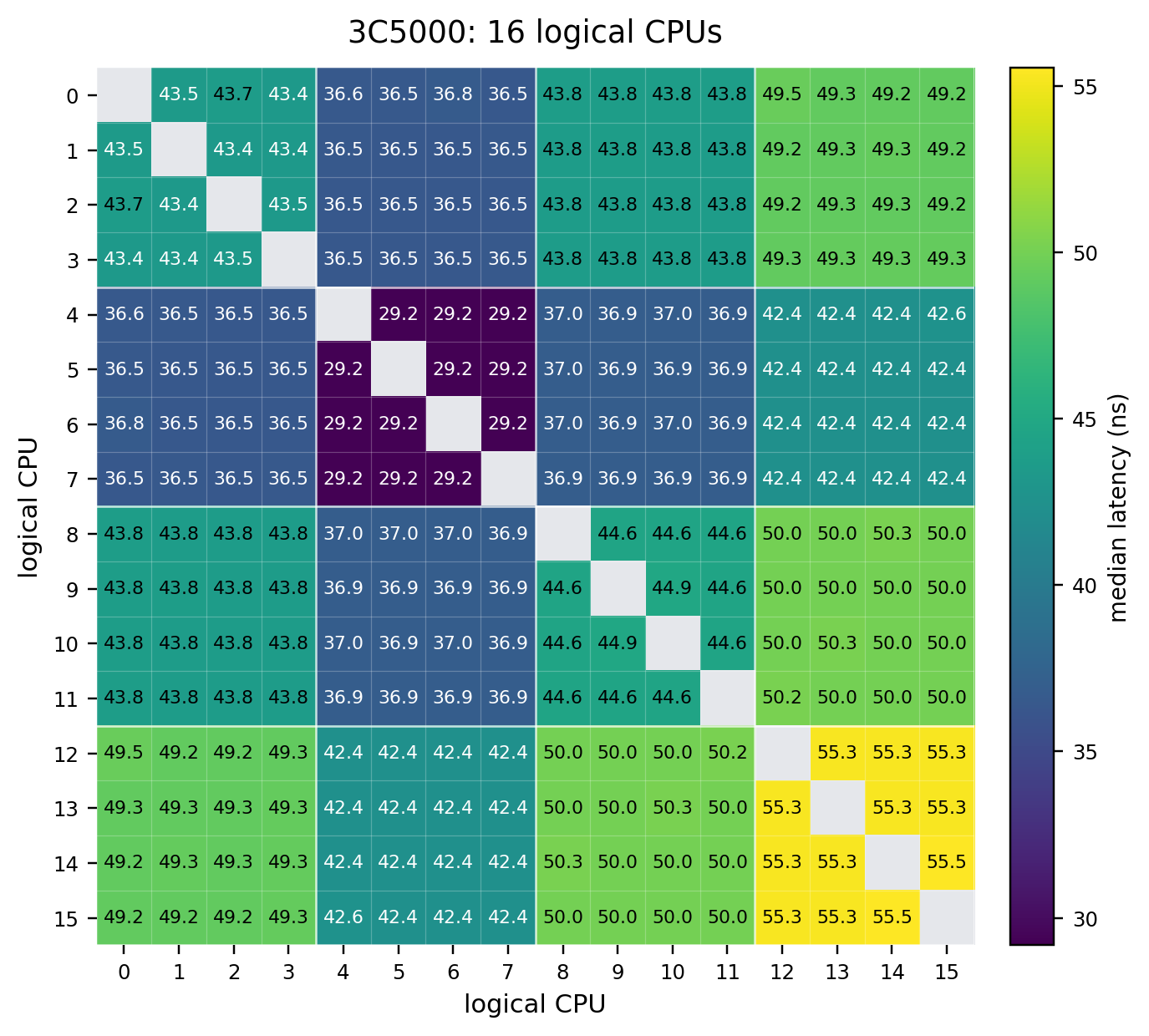
The 16 cores span 29 to 56 ns. The matrix is not flat: cores 4 to 7 are consistently faster to reach than cores 12 to 15, and the four bands of four cores are visible. All 16 cores are in the same NUMA node and share 32 MB of L3, but the L3 is split into four partitions. The bands may therefore reflect partition distance rather than NUMA. Within a band, a pair is not faster than a pair across bands, so they are not local clusters either; the pattern is closer to a fixed offset per core. The CSV is a core-by-core matrix, but it does not say which cores share an L3 group, so the page describes the bands without naming the clusters. What matters for software is the spread: a line transfer can cost twice as much depending on which core pair is involved.
3C6000/S
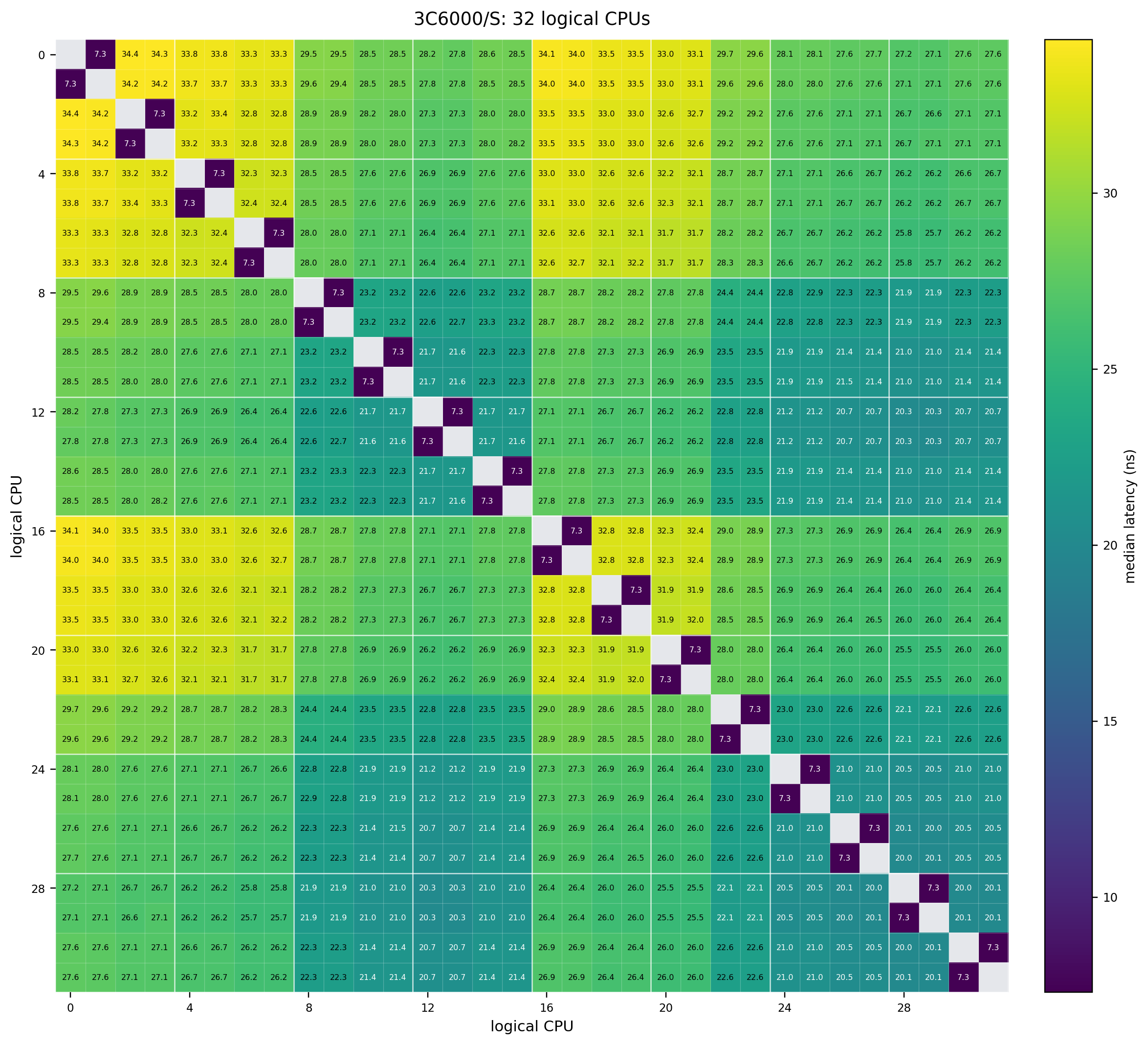
The physical machine exposes 32 logical CPUs and spans 7 to 34 ns, with a median of 27 ns. The low end, 7.3 ns, is SMT sibling traffic, not core-to-core communication. The rest of the matrix runs from about 20 to 34 ns. This run used the performance governor; earlier runs on the same machine spanned 7 to 61 ns and 7 to 112 ns, with several sibling outliers.
The matrix is not uniform, and the 32 by 32 grid is dense, so open the image at full size to read the values cell by cell. The CSV is a core-by-core matrix, but it does not say which cores share a cluster or a NUMA node, so the page does not assign the high-latency pairs to a particular hardware boundary.
The 3C6000/S has SMT: 0 and 1 are siblings, 2 and 3 are siblings, and so on. All 16 sibling pairs measure 7.3 ns in this run. Earlier runs with the default governor put some of them at 20 to 39 ns; those were frequency or scheduling artifacts rather than a property of the cores. Excluding all sibling pairs, the cross-core median is 26.9 ns.
What the matrix says about the fabric
The cross-core part of both matrices is almost additive. For the 3C6000/S,
after removing the 16 SMT pairs, fitting latency(i,j) = a_i + a_j - mean
leaves a residual standard deviation of 0.4 ns and a maximum residual of 1.5 ns.
The 3C5000 is similar, at 0.4 ns and 1.1 ns. Grouping cores into blocks of two,
four, or eight gives the same mean latency within a block as across blocks.
That is what a shared L3 and a common interconnect path look like: each core contributes a fixed offset, and a pair's latency is the sum of the two offsets. It is not what local L3 clusters or direct neighbor links look like, because those would make some pairs cheaper. The four bands are therefore per-core attachment offsets, not four local clusters.
Latency alone cannot distinguish a ring, a mesh, and a crossbar. That needs bandwidth under concurrent pairs, uncore counters, or an address-slice sweep.
What this means for software
These are the costs that a synchronization operation pays before any lock algorithm runs. A contended lock or a cache line bouncing between cores is limited by the transfer time, not by the atomic instruction's own latency. On the 3C5000 the spread is large enough that which cores share data matters; on the 3C6000/S the spread is smaller, but a cross-core handoff is still an order of magnitude above an L1 hit.
Keep shared mutable data on one core when possible, pad hot per-thread state to a cache line, and avoid designs that hand a line back and forth between cores. For the atomic and barrier side of the same problem, see Atomics and memory ordering.